ChatGPT
G2G learning might sound like another three letter acronym, but at Google it is a big part of how people actually learn, share know how, and grow their careers.
What is G2G learning? G2G is employees teaching peers to share practical knowledge.
According to Google, around 80% of their training is delivered through an employee to employee network called g2g – short for Googler to Googler. This G2G learning approach means thousands of people across the business volunteer to teach, coach, and support their peers.
This is not about cutting costs or pushing more work onto already busy teams. G2G learning is about building a culture where learning is something people do together, in the moments that matter, instead of something that just happens in a classroom once a year.
In this article we will look at what G2G learning is, why it works so well for Google, and how you can use the same principles to boost knowledge and performance for your own frontline teams.
Get your free measurable learning guide
Want to learn more about making learning measurable? Download our free guide to measurable learning in retail and frontline operations. You’ll get practical frameworks, templates, and strategies to prove the value of peer to peer learning, G2G learning, and peer learning in your organisation.
What is G2G learning?
G2G learning is peer to peer learning at scale. Rather than relying only on L&D or external trainers, employees volunteer to:
- Design and deliver sessions on topics they know well
- Share best practice and how they really do things day to day
- Coach colleagues on new skills and behaviours
- Answer questions in the flow of work
At Google there are more than 6,000 employees involved in their G2G learning programme. They run everything from leadership and negotiation skills to sales training and Python coding.
The key point is that the people teaching are the people who actually do the job. They know the systems, shortcuts, customers, and challenges – just like your store managers, team leaders, or engineers do.
When G2G learning comes from peers, it feels immediately more relevant and practical. It is rooted in the reality of the frontline, not just in theory.
Why Google say G2G learning works
Google describe their G2G learning programme as successful because it:
- Improves knowledge sharing. People pass on what works, what does not, and what has changed recently.
- Makes employees owners of their development. People choose what they teach and what they learn, instead of waiting for a course to appear in their inbox.
- Supports learning in the moment. Sessions and resources are focused on real challenges, not generic content.
We see the same thing with frontline teams using Ocasta for peer to peer learning and G2G learning. When people can quickly share how they solve problems, and others can search or ask for that knowledge when they need it, performance improves fast.
That is why our frontline operations platform gives staff a searchable, always up to date knowledge and learning hub – like a Google for your business – alongside tools for observations, coaching, comms, and checklists. It means:
- Your best practice is captured once and shared everywhere
- People can learn at the moment of need, not weeks later
- You stop guessing and start knowing what is really happening on the frontline
Access the measurable learning guide
Discover practical frameworks for measuring peer to peer learning and G2G learning impact in our free measurable learning guide. You’ll get step-by-step processes, measurement templates, and case studies that show you how to prove the value of peer to peer learning programmes.
How to build your own peer to peer learning programme
You do not need Google’s budget or brand to make G2G style learning work. You just need the right culture, structure, and tools.
Here are seven practical steps to help you get started.
1. Create a continuous learning environment
Peer to peer learning and G2G learning only work if your culture already values learning. If people think “training” is a one off event in a meeting room, they are unlikely to volunteer their time or attention to a peer to peer learning programme.
Start by making it clear that learning is:
- Part of everyone’s job, not an optional extra
- Something that happens every day, in every role
- For experienced people as much as new starters
You can take inspiration from how Google describe learning:
- Learning is a process, not an event. It needs motivation, practice, and feedback.
- Learning happens in real life. It shows up during transitions and challenging moments.
- Learning is personal. Everyone has different learning styles, confidence levels, and comfort zones.
- Learning is social. People learn better when they connect with peers for advice and support.
To bring this to life for your frontline teams you can:
- Use your internal comms hub to share regular stories of people learning from each other
- Celebrate when teams try something new, not just when metrics improve
- Make sure leaders talk openly about their own learning, not just the team’s
Over time, learning becomes something people expect and look for, not something done to them.
2. Bake peer learning into onboarding
If you want people to see learning as part of their role, start on day one.
During preboarding and onboarding:
- Set the expectation that everyone will both learn from others and share what they know
- Introduce new starters to your peer coaches, champions, or g2g volunteers
- Give them easy access to your new starter hub so they can explore knowledge, videos, and microlearning at their own pace
You can also:
- Invite new starters to shadow a peer led session early on
- Ask them which topics they would like more peer support on
- Show examples of how previous new starters have gone on to become coaches or trainers
This gives people confidence and a clear path from learner to future trainer.
3. Choose the right volunteers with simple interviews
Passion for teaching is important, but it is not enough on its own. Your volunteers need to be credible in the subject they teach, keen to learn, and willing to invest time.
A light interview process helps you:
- Find people who are strong on both expertise and attitude
- Set expectations about the time and support involved
- Understand where they may need coaching themselves
You can use questions similar to those Google suggest (see the full interview guide here):
- Why are you interested in becoming a facilitator?
- What are you hoping to get out of the role?
- How will this complement your core role?
- What previous experience have you had teaching or training?
- Which skills do you think are most important for a facilitator, and which do you already have?
- What might you find challenging in this role, and what support would you need?
You do not need a huge, formal process. A 20 minute conversation can be enough to spot the people who will thrive in a peer to peer learning or G2G learning programme.
4. Train your trainers properly
Teaching peers is not easy. It is not just about knowing the content, it is about making it engaging, practical, and safe for people to ask questions.
Your volunteers will need support with:
- Structuring sessions around clear outcomes
- Using stories and examples from your own business
- Handling tricky questions and disengaged learners
- Giving practical activities, not just slides
This is where your knowledge and learning hub can help:
- Host short microlearning modules on “how to run a great session” or “how to coach in the moment”
- Share checklists for running a session, from setting objectives to follow up
- Store templates for slide decks, handouts, and follow up microlearning
Try an example of quick microlearning now with this quiz 👇
You can also pair new volunteers with experienced ones so they can co deliver a session before taking one on their own.
Here is a link to the workbook which Google has provided to improve teaching skills.
Download the measurable learning guide
Learn how to measure whether your training is working with our free measurable learning guide. Get access to observation frameworks, feedback templates, and measurement strategies that show you exactly how to track training effectiveness.
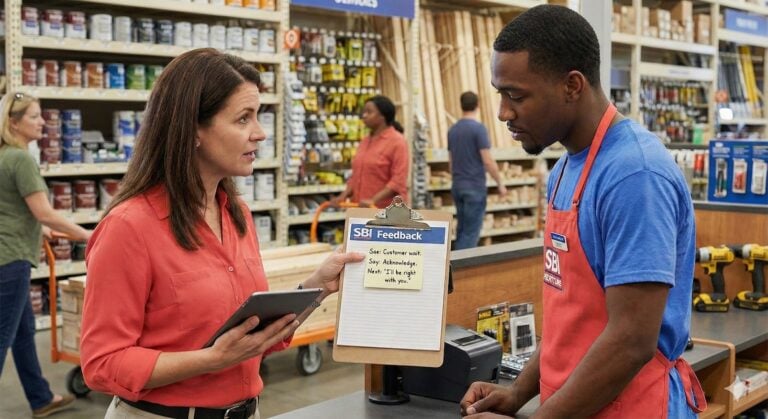
5. Use observations and feedback to keep quality high
The biggest risk with peer to peer learning and G2G learning is inconsistent quality. If you launch a peer to peer learning programme and leave it to run itself, standards will quickly drift.
This is where structured observations really earn their place. They let you see what people actually do after a session — not just who ticked a completion box.
Instead, build in regular observation and feedback.
You can:
- Ask managers or L&D partners to observe sessions using the observation and coaching hub
- Capture strengths and opportunities in a simple digital checklist during or straight after the session
- Add photos, comments, and tasks so nothing gets lost
- Spot common gaps across sites so L&D can update content, not just chase completions
For example, if a sales training volunteer needs to improve closing skills, a manager could:
- Capture this in a quick observation report
- Assign a task to complete a specific microlearning lesson
- Set a follow up observation to see what has changed
You should also collect feedback from learners after each session. Simple questions work best:
- How engaging was your trainer?
- How clearly did they explain the topic?
- Did you feel comfortable asking questions?
- How confident do you feel now compared with before the session?
- What was the most useful thing you learned?
- What would you improve next time?
This gives your volunteers clear, fair feedback and helps you see which sessions are having the biggest impact.
6. Recognise and reward your volunteers
Peer to peer learning and G2G learning run on goodwill. If you ignore the effort involved in your peer to peer learning programme, motivation will drop.
The good news is that recognition does not have to be complicated or expensive.
You can:
- Ask managers to personally thank volunteers after sessions
- Call out great sessions in your internal comms feed
- Build milestones into your development and promotion pathways
For example, you might:
- Recognise someone when they have delivered their first session
- Celebrate when a volunteer maintains high learner feedback scores over several weeks
- Include “peer coach” responsibilities in role profiles for senior frontline roles
With Ocasta you can take this further by using the internal comms hub to send digital shout outs and our reward and recognition tools to send stickers or trophies to people’s devices. Managers and peers can use these to recognise effort, improvements, and impact.
Done well, recognition reinforces that peer to peer learning and G2G learning are important and valued, not just something people do on top of their day job.
Access the measurable learning guide
7. Use light touch checklists to support consistency
Finally, treat every peer led session as a repeatable process, not a one off event.
Checklists should support your observations, not replace them. Think of them as a simple way to keep the basics on track so your coaches can focus on the human side of learning.
Create simple checklists for your volunteers to complete before and after each session. For example:
- Do learners leave with a simple summary of the key takeaways?
- Is there a clear 20/80 mix between slides and discussion or practice?
- Have you set up a follow up microlearning playlist in the app?
- Is the session under an hour where possible?
- Can you write a single, clear sentence that sums up the core message?
You can make these part of your inspections and checklist hub, so volunteers can quickly swipe through and add comments on their device.
Completed checklists go straight back to head office or your L&D team, giving you a live view of how peer to peer learning and G2G learning are being delivered across sites.
Used alongside observations, they help you keep standards high without turning learning into a box ticking exercise.
Download the measurable learning guide
Get practical checklists and measurement frameworks in our free measurable learning guide. Enter your email below to get instant access to ready-to-use templates, frameworks, and step-by-step processes you can implement today.
Bringing it all together: G2G learning for frontline teams
Google’s G2G learning programme shows what is possible when you trust your people to teach each other and give them the right structure and support.
For frontline teams, the same principles apply:
- Capture what your best people do in the moments that matter
- Make it easy for others to learn that knowledge quickly
- Use observations, coaching, and light touch checklists to keep quality high
- Recognise and reward the people who share what they know
Ocasta’s frontline operations platform brings this together in one place:
- A knowledge and learning hub for search, microlearning, and knowledge checks
- An observation and coaching hub for in the moment coaching, feedback, and truly measurable learning
- An internal comms hub for targeted updates, recognition, and stories
- A new starter hub to get new people confident and connected before day one
- An inspections and checklist hub for simple, supportive processes
So whether you are looking to boost in the moment mentoring, support peer to peer learning and G2G learning programmes, or just improve how knowledge flows across your frontline, you do not have to guess.
You can see what is working, fix what is not, and give people the tools they need to learn from each other every day.
If you would like to see how Ocasta can support peer to peer learning and G2G learning programmes in your own organisation, I would be happy to show you around.
Download your free measurable learning guide
Ready to make peer to peer learning and G2G learning measurable? Download our free guide to measurable learning in retail and frontline operations. Enter your email below to get instant access to the complete guide with frameworks, templates, measurement strategies, and real-world case studies for peer to peer learning programmes.