
 ChatGPT
AI is everywhere in retail conversations.
But much of that conversation focuses on ecommerce, online personalisation, customer data and digital conversion. Physical stores need a different discussion.
The useful question is not:
Where can we add AI?
It is:
Which store problems are we trying to solve, and where should people remain firmly in control?
For store operations, AI has the most value when it removes the repetitive work keeping managers away from their teams and customers.
It can reduce reporting, surface patterns, improve access to knowledge and help managers prepare for better coaching conversations.
But it should not take over the moments that rely on empathy, trust, curiosity and human judgement.
The best approach is to assess each store moment in one of three ways:
- Automate it
- Support it
- Protect it
This gives retailers a practical way to use AI without losing sight of why customers still choose to visit stores.
AI can support the store. People make it worth visiting.
Physical stores need a different AI conversation
A physical store is not simply another transaction channel.
Customers arrive with questions, uncertainty, frustration, excitement and decisions to make. They may need reassurance before a large purchase, advice about a product they do not fully understand or empathy when something has gone wrong.
A colleague needs to read those signals and decide how to respond.
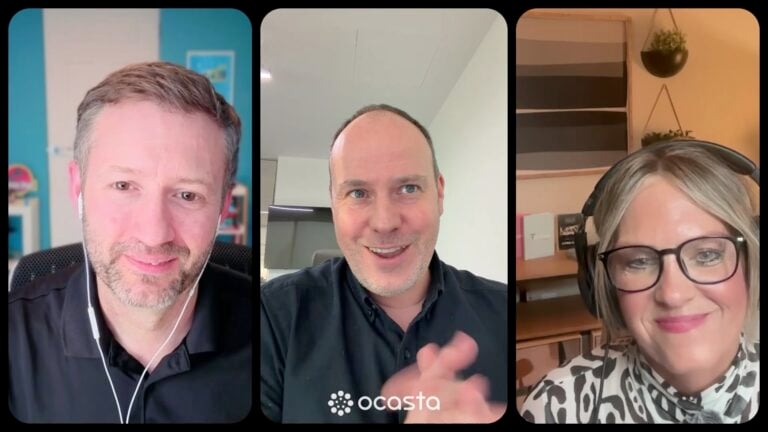
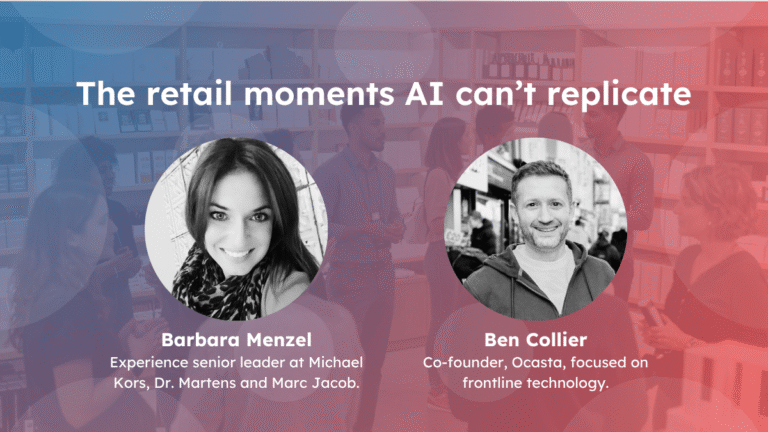
During our recent live discussion, Barbara Menzel shared the example of a customer who entered a store to return an item.
Rather than simply processing the refund, the colleague asked why the product had not worked. That question led to a conversation about fit and colour, which developed into a styling session. The customer left with three items and greater confidence in her choice.
The value did not come from processing the return more efficiently.
It came from curiosity, judgement and the ability to understand what the customer really needed.
That is the distinction retailers need to make.
Some parts of store operations should become faster and more automated. Other moments should use technology quietly in the background, giving people more capacity to do the human work well.
The best store AI may be invisible to customers
The most useful applications of AI in physical retail may not be the most noticeable.
Customers do not need a store full of AI-branded experiences. They need products to be available, colleagues to know what they are talking about and managers to have enough time to support their teams.
AI can improve that experience without becoming the experience.
It can:
- Reduce time spent compiling reports
- Summarise operational information
- Highlight patterns across stores
- Improve labour planning
- Prioritise tasks
- Surface product and process knowledge
- Identify repeated coaching needs
- Help area managers prepare more focused store visits
Barbara described how producing a weekly executive report previously took almost an entire Monday. Information had to be pulled from several sources, formatted, interpreted and summarised manually.
With the right AI tools, the same work could be reduced to around 60 to 90 minutes.
That is a meaningful use of AI in store operations.
It does not remove the retail leader. It gives them back time for commercial decisions, store visits and coaching.
“AI is about removing admin, not removing people.“
Barbara Menzel
The automate, support, protect framework
Before introducing AI into any store process, retailers should decide which of these three roles it should play.
| Decision | Use it when | Store examples |
|---|---|---|
| Automate | The work is repetitive and rules-based | Reporting, task routing, stock prompts, routine reminders |
| Support | A person still owns the decision | Product answers, coaching prompts, summaries, suggested learning |
| Protect | Trust, empathy or judgement shapes the outcome | Complaints, reassurance, selling, coaching, reading customer intent |
1. Automate repetitive work
Automation works best when the task is repetitive, rules-based and does not depend on empathy or interpretation.
This is often the operational work that pulls managers into the back office.
Store tasks that may be suitable for automation
- Compiling routine reports
- Summarising data from several systems
- Routing tasks to the right location
- Sending recurring compliance reminders
- Flagging potential stock gaps
- Creating replenishment prompts
- Producing initial labour forecasts
- Consolidating store updates
- Highlighting missed deadlines
- Preparing daily operational summaries
The principle is simple:
Automate the work that keeps people away from the shop floor.
That does not mean managers should lose control.
A labour-planning tool might produce a suggested rota, but the manager should still be able to apply local knowledge. They may know about an event, an unusually experienced colleague or a customer pattern that the data has not fully captured.
The technology should handle the repetitive first draft. The manager should retain responsibility for the final decision.
The language used around these tools also matters.
Call something an automated replacement and managers may feel their judgement is being removed. Position it as an assistant that saves time while leaving them in control, and the response can be very different.
Questions to ask before automating
- Is the work repetitive?
- Is there a clear and consistent outcome?
- Does it take managers away from customers or teams?
- Would automation reduce errors or delays?
- Is human judgement only needed when something unusual happens?
- Can a person review and override the output?
When those answers are mostly yes, automation is likely to be useful.
2. Support frontline judgement
Some store moments should not be automated because a person still needs to interpret the context and make the decision.
AI can still support them.
This is where AI works as an assistant: providing relevant information, identifying patterns or suggesting a starting point without taking control away from the manager or colleague.
Store tasks where AI can support people
- Finding product information quickly
- Answering process and policy questions
- Summarising observation results
- Suggesting coaching prompts
- Recommending relevant learning
- Highlighting repeated skills gaps
- Preparing an area manager for a store visit
- Identifying stores that may need more support
- Summarising operational comms
- Suggesting follow-up actions after an observation
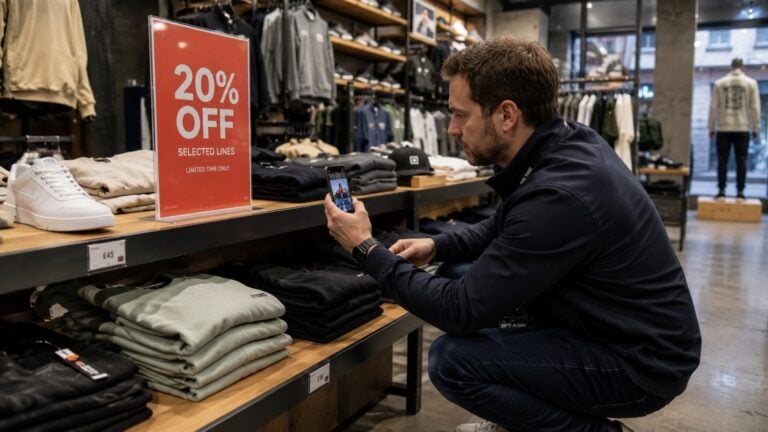
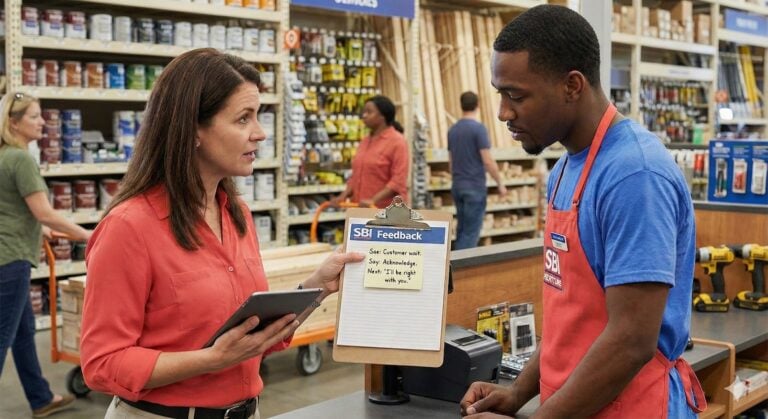
For example, a manager may observe a customer interaction and notice that the colleague asked strong discovery questions but missed the opportunity to recommend a relevant additional product.
AI could help the manager by suggesting:
- A useful coaching question
- A clear way to recognise what went well
- A relevant knowledge resource
- A practical follow-up action
But the manager still needs to decide how to deliver that feedback.
They understand the person, the context and the tone the conversation needs.
How Ocasta applies the support principle
At Ocasta, our approach is to use AI as an assistant to the manager, not a replacement for them.
Frontline teams can ask a question and get an answer drawn from the organisation’s comms and knowledge. This reduces the time spent searching through emails, documents and different systems, giving people the information they need while the moment is still useful.
We are also developing AI support for coaching.
After a manager completes a real behavioural observation, AI can use the recorded information to suggest:
- Coaching talking points
- Questions the manager could ask
- Relevant knowledge or learning
- Practical follow-up actions
But it should not deliver the coaching itself.
The manager still understands the colleague, the context and the tone the conversation needs. AI provides a useful starting point. The manager makes it human.
The technology supports the conversation. It does not replace it.
This is an important difference.
A tool that gives a colleague an automated list of everything they did wrong may be efficient, but it removes the manager from one of the most valuable parts of their role.
A coaching assistant should help managers have better human conversations, not avoid them.
Questions to ask before using AI as support
- Does someone still need to interpret the situation?
- Would better information improve the decision?
- Does local context matter?
- Should a person remain accountable for the outcome?
- Could AI reduce preparation time without replacing the conversation?
- Would the person still feel in control?
When those answers are yes, AI should support the moment rather than automate it.
3. Protect the human moment
Some moments should remain human because the relationship is part of the outcome.
These moments rely on empathy, trust, judgement, confidence or the ability to notice what is not being said.
Store moments to protect
- Handling a complaint
- Reassuring a hesitant customer
- Understanding the meaning behind a purchase
- Knowing when to approach or step back
- Adapting a sales conversation
- Coaching a colleague
- Supporting someone who feels overwhelmed
- Recovering a poor customer experience
- Building trust during a high-value purchase
- Helping a new starter gain confidence
AI may provide useful information around these moments.
It might surface the returns policy, suggest relevant product details or highlight that a behaviour has been missed repeatedly.
But it should not become the interaction itself.
Barbara described some of the moments that still depend on people: reading customer intent, knowing when to approach, handling complaints with genuine empathy and coaching someone in the right tone while the moment is still useful.
These moments are not vague or impossible to improve.
They can be broken down into observable behaviours.
A manager can look for whether a colleague:
- Acknowledged the customer
- Asked an open question
- Listened before recommending
- Gave the customer space
- Noticed hesitation
- Adapted their approach
- Explained the next step clearly
- Responded calmly to frustration
The human moment should be protected, but the behaviours behind it can still be observed, coached and strengthened.
Questions to ask before protecting a moment
- Is the customer bringing emotion into the interaction?
- Could the wrong response damage trust?
- Does someone need to read body language, tone or hesitation?
- Is the relationship as important as the task?
- Does the colleague need freedom to adapt?
- Would automation make the experience feel colder or less personal?
When those answers are yes, keep the person at the centre.
A simple decision flow for store operations
For any process or customer moment, ask these questions in order.
Does it rely on empathy, trust or human judgement?
If yes, protect it.
Keep the person in control and use technology only where it adds context or removes friction.
Does someone still need to interpret the situation or make the final decision?
If yes, support it.
Use AI to suggest, summarise or surface information, but leave the judgement with the colleague or manager.
Is it repetitive, rules-based and pulling people away from customers?
If yes, automate it.
Let technology handle the repeatable work, with suitable checks and the ability for people to intervene.
Still uncertain?
Introduce it as an assistant first.
Testing AI as support is usually safer than immediately handing over an entire decision.
What this means for store managers
The store manager role has always involved more than opening the store, managing the rota and tracking sales.
The strongest managers build confidence and capability across their teams.
They notice when someone needs support. They recognise good performance. They coach behaviours while the customer interaction is still fresh. They create the conditions for consistent service.
As Barbara put it during the discussion, the best store managers already carry out many of the responsibilities associated with learning and development, even when the business does not describe the role in that way.
The problem is that they cannot coach if they are trapped in admin and firefighting.
AI should create more space for that part of the job.
It should not reduce managers to simply approving automated decisions.
A useful test is to ask:
Does this technology give the manager more time and insight to support their people, or does it remove their judgement from the process?
The first strengthens the role.
The second risks making the manager less capable over time.
The experience behind the customer experience
Retailers spend a great deal of time thinking about customer experience.
They consider the lighting, layout, music, product displays, promotions and customer journey. Stores are often deliberately shaped to stimulate, excite and engage.
But the people creating that experience are having an experience too.
A colleague may spend eight hours surrounded by noise, movement, questions, queues, visual displays and constant social interaction.
That can be energising for some people. For others, it can be tiring or overwhelming.
The answer is not to remove the human nature of retail. The job will always involve people, pressure and changing situations.
But retailers can think more carefully about the conditions in which people are expected to perform.
That can include:
- Clearer task priorities
- Faster access to reliable knowledge
- Less repeated reporting
- Better shift planning
- Time to reset after a difficult interaction
- Managers who notice pressure building
- Coaching that builds confidence rather than simply identifying mistakes
Better support does not lower the standard.
It helps more people reach it.
If human judgement is a store advantage, retailers need to create the conditions in which colleagues can use it well.
Observation turns human judgement into something coachable
Retailers often use phrases such as “deliver excellent service” or “create memorable customer experiences”.
The problem is that these expectations are difficult to coach unless they are translated into behaviours.
A manager cannot usefully coach “be more memorable”.
They can coach:
- Ask one more open question
- Acknowledge the concern before explaining the policy
- Link the recommendation to the customer’s need
- Give the customer time before approaching again
- Offer a clear next step
- Check whether the customer feels confident in the decision
This is why regular observations matter.
The feedback can happen two minutes after the interaction, rather than months later in a performance review.
Barbara highlighted that the strongest managers coach while the moment is still fresh, because that is when behaviour is most likely to change.
AI can support that process by summarising patterns or suggesting prompts.
The coaching conversation should still belong to the manager.
Head office should serve stores
AI in store operations should also improve the relationship between stores and head office.
Too often, store managers spend their time feeding information upwards:
- Joining repeated calls
- Completing reports
- Reformatting data
- Responding to overlapping requests
- Searching for the latest version of a process
- Proving that tasks have been completed
That takes them away from customers and teams.
Barbara argued that head office should send stores clarity and insight, rather than continually asking them for more data. The flow of value should work both ways.
A useful AI-supported daily view might tell a manager:
- The three priorities for today
- What has changed
- Which task needs immediate action
- Where the team may need coaching
- Which operational risk requires attention
The aim is not to give managers more data.
It is to give them better knowledge.
Area managers need insight, not more paperwork
The same principle applies to area and regional managers.
Their value comes from being in stores, sharing experience, coaching leaders and spotting patterns across a region.
They should not spend most of their time travelling simply to check whether forms have been completed.
With better operational insight, an area manager can focus each visit around a real need.
For example:
- A store has a repeated product knowledge gap
- A region is struggling to ask open questions
- One team is performing strongly in customer approach
- A location needs support with loss prevention
- A manager needs help building a coaching rhythm
This also allows retailers to identify strengths.
A colleague who is excellent at product knowledge might support someone in another store. A team that handles customer approach particularly well could share a short example with the wider business.
AI and operational data should not only show what is wrong.
They should make it easier to find what is already working and spread it.
Use AI quietly and practically
There is pressure on every retailer to have an AI strategy.
But store operations do not need AI for the sake of a headline.
They need practical technology that:
- Removes unnecessary admin
- Gives people faster access to knowledge
- Helps managers see where support is needed
- Makes coaching more consistent
- Gives area managers clearer priorities
- Keeps people in front of customers
The best starting point is not the technology.
It is the store moment.
Ask what the customer needs, what the colleague needs to notice, what the manager needs to coach and what friction can be removed around them.
Then decide whether to automate, support or protect it.
AI can support the store. People make it worth visiting.
Take the guesswork out of store performance
Ocasta’s observations & coaching hub gives managers a practical way to observe real customer interactions, coach while the moment is fresh and turn skills gaps into clear action.
AI supports the manager by making relevant knowledge easier to find. We are also developing tools that can help interpret observed behaviours and suggest useful coaching prompts, learning and follow-up actions.
The manager remains in control of the conversation and the action that follows.
That reflects the wider framework:
- Automate repetitive work
- Support people with better knowledge
- Protect the moments that rely on human judgement
Stop guessing. Start knowing.